你好,我是孔令飞。
上一节课,我介绍了 kube-apiserver 中安装资源路由的整个流程。在一个 REST 请求到达 kube-apiserver 实例后,kube-apiserver 中的路由表会匹配 HTTP 请求方法、HTTP 请求路径,并根据匹配结果找到对应的路由函数,也即处理函数(也称 Handler/Controller),处理 HTTP 请求。
本节课,我就来详细介绍下路由函数的实现,通过路由函数实现,我们可以掌握到 kube-apiserver 具体是如何处理请求的。我们先来看下,Kubernetes 中的 HTTP 请求处理流程。
路由函数相关目录及结构
Kuberenets 路由函数都统一存放在 registry 目录下。registry 目录内容如下:
$ ls registry/
admissionregistration  apps            authorization  batch         coordination  discovery  events       networking  OWNERS  rbac          resource    storage
apiserverinternal      authentication  autoscaling    certificates  core          doc.go     flowcontrol  node        policy  registrytest  scheduling  storagemigration
registry 目录结构体如下:
registry/
├── ...
├── apps # 保存了 apps 资源组下所有版本、所有资源的请求处理逻辑
│   ├── ...
│   ├── daemonset # daemonset 资源所有版本的路由函数
│   │   ├── doc.go # daemonset 包的文档说明
│   │   ├── storage # 保存了存储层的具体已实现
│   │   │   ├── storage.go # 这个文件定义了与 daemonset 资源对象交互的存储逻辑,包括对象的创建、更新、删除等操作
│   │   │   └── storage_test.go # 单元测试文件,用于测试 storage.go 文件中的函数或方法
│   │   ├── strategy.go # 包含实现 daemonset 资源对象的策略(如创建、更新、删除时的验证和转换逻辑)
│   │   └── strategy_test.go # 单元测试文件,用于测试 strategy.go 文件中的函数或方法
│   ├── deployment # 保存了 deployment 资源所有版本的路由函数。目录下文件的功能跟 daemonset 目录相似
│   │   ├── doc.go
│   │   ├── storage
│   │   │   ├── storage.go
│   │   │   └── storage_test.go
│   │   ├── strategy.go
│   │   └── strategy_test.go
│   ├── ...
│   ├── rest
│   │   └── storage_apps.go # 包含了创建 apps 资源组 RESTStorage 的结构体和方法
│   └── ...
├── ...
├── batch # 保存了 batch 资源组下所有版本、所有资源的 REST 路由函数。目录下文件的功能跟 apps 资源组相似
│   ├── ...
├── ...
可以看到,registry 目录下,包含了 Kubernetes 所有内置资源的 CURD 等操作的具体实现逻辑。这些处理逻辑主要包括:
-
对象的处理策略:用来告诉 kube-aiserver,在处理 HTTP 请求逻辑之前,需要执行的一些操作。例如:对象创建前执行的操作、资源更新前操作、资源验证、对象转换等操作。
-
HTTP 请求处理方法:这些方法用来处理指定的 HTTP 请求。在 kube-apiserver 中,这些处理方法会进行一些逻辑处理,并将处理后的资源保存在后端存储中,也就是 etcd 中。Kubernets 资源通常会包含以下方法:
-
Create:处理资源创建的 HTTP Handler;
-
Get:处理获取资源详情的 HTTP Handler;
-
Update:处理更新资源的 HTTP Handler;
-
Destroy:处理销毁资源的 HTTP Handler;
-
ConvertToTable:用来将资源对象转换为表格格式,以便在 Kubernetes 的 CLI 或 API 响应中以表格形式展示。
-
另外,每个资源组目录下,还有一个 rest 目录,rest 目录中定义了一个名为 StorageProvider 的结构体,该结构体中包含了 NewRESTStorage 方法,NewRESTStorage 方法可以用来创建 APIGroupInfo 类型的实例,APIGroupInfo 定义如下:
// Info about an API group.
type APIGroupInfo struct {
    PrioritizedVersions []schema.GroupVersion
    // Info about the resources in this group. It's a map from version to resource to the storage.
    VersionedResourcesStorageMap map[string]map[string]rest.Storage
    // OptionsExternalVersion controls the APIVersion used for common objects in the
    // schema like api.Status, api.DeleteOptions, and metav1.ListOptions. Other implementors may
    // define a version "v1beta1" but want to use the Kubernetes "v1" internal objects.
    // If nil, defaults to groupMeta.GroupVersion.
    // TODO: Remove this when https://github.com/kubernetes/kubernetes/issues/19018 is fixed.
    OptionsExternalVersion *schema.GroupVersion
    // MetaGroupVersion defaults to "meta.k8s.io/v1" and is the scheme group version used to decode
    // common API implementations like ListOptions. Future changes will allow this to vary by group
    // version (for when the inevitable meta/v2 group emerges).
    MetaGroupVersion *schema.GroupVersion

    // Scheme includes all of the types used by this group and how to convert between them (or
    // to convert objects from outside of this group that are accepted in this API).
    // TODO: replace with interfaces
    Scheme *runtime.Scheme
    // NegotiatedSerializer controls how this group encodes and decodes data
    NegotiatedSerializer runtime.NegotiatedSerializer
    // ParameterCodec performs conversions for query parameters passed to API calls
    ParameterCodec runtime.ParameterCodec

    // StaticOpenAPISpec is the spec derived from the definitions of all resources installed together.
    // It is set during InstallAPIGroups, InstallAPIGroup, and InstallLegacyAPIGroup.
    StaticOpenAPISpec map[string]*spec.Schema
}
APIGroupInfo 结构体包含了所有用来构建 HTTP 路由的信息。另外 StorageProvider结构体还包含了 GroupName() 方法,该方法可以返回资源组的组名。
上面,我从目录结构维度,给你介绍了 registry 目录下的文件及其功能。接下来,我来给你介绍下 kube-apiserver 具体是如何处理一个 HTTP 请求的。
kube-apiserver 处理 HTTP 请求的流程
为了能够给你清晰地讲解 kube-apiserver 具体是如何处理 HTTP 请求的,这里按照 HTTP 请求处理流程分享,会涉及流程中的各个关键处理环节。
这里我们先通过一张图,从上层视角看一下 kube-apiserver 处理 HTTP 请求的流程。处理流程如下:
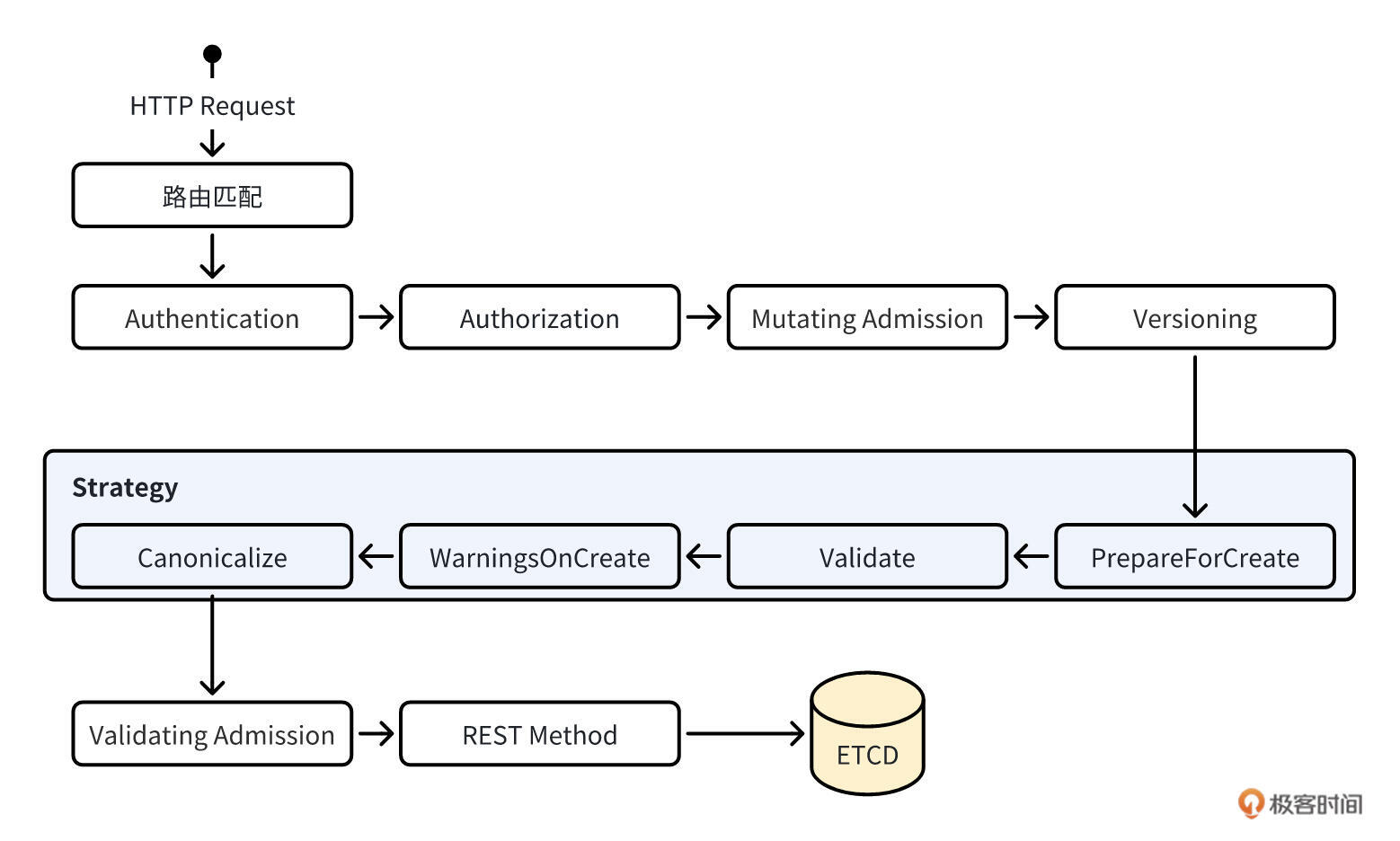
当 kube-apiserver 收到一个 HTTP 请求之后,会先执行路由匹配,找到匹配的路由之后,会执行该路由中添加的 HTTP 处理链。通过上一节课的讲解,我们知道,kube-apiserver 在启动时,添加了众多的 HTTP 处理链。上图中的 Authentication 和 Authorization 就是其中的两个处理链,分别进行请求认证和请求鉴权。关于认证和鉴权,本课程中会有专门的课程来讲解,这节课就不展开了。
在认证和鉴权通过之后,会分别执行 Mutating Admission Controller 和 Validating Admission Controller。在两个 Admission Webhook 执行完之后,Versioning 逻辑用来将版本化的资源转换为内部版本资源。这样的操作,可以使之后的处理逻辑不会因为资源版本不一致而不同。
之后会执行资源创建前的处理策略,链路为:PrepareForCreate -> Validate -> WarningsOnCreate -> Canonicalize。在 Kubernetes 开发中,我们需要关注 Validate 链路,因为我们经常需要为自定义资源添加参数校验逻辑。
在执行完 Strategy 链路之后,会进入到 REST Method 节点。REST Method 会对请求进行真正的业务逻辑处理,并将处理后的资源数据保存在 etcd 数据库中。
上面的这些处理点,每个点都包含了大量的内容。所以本门课程会分开介绍每个节点的具体实现。本节课,我们主要介绍上述处理点中的 REST Strategy 和 REST Method 部分。这两个部分是真正执行 HTTP 请求处理逻辑的 2 个节点。
请求到达路由函数(以创建请求为例)
通过上一节课的学习,我们可以知道 kube-apiserver 最终是通过调用以下代码来安装路由的。例如,安装资源的创建路由代码如下:
// 位于文件 staging/src/k8s.io/apiserver/pkg/endpoints/installer.go 中
func (a *APIInstaller) registerResourceHandlers(path string, storage rest.Storage, ws *restful.WebService) (*metav1.APIResource, *storageversion.ResourceInfo, error) {
        ...
        namedCreater, isNamedCreater := storage.(rest.NamedCreater)
        ...
        switch action.Verb {
        ...
        case "POST": // Create a resource.
            var handler restful.RouteFunction
            if isNamedCreater {
                handler = restfulCreateNamedResource(namedCreater, reqScope, admit)
            } else {
                handler = restfulCreateResource(creater, reqScope, admit)
            }
            handler = metrics.InstrumentRouteFunc(action.Verb, group, version, resource, subresource, requestScope, metrics.APIServerComponent, deprecated, removedRelease,handler)
            handler = utilwarning.AddWarningsHandler(handler, warnings)
            article := GetArticleForNoun(kind, " ")
            doc := "create" + article + kind
            if isSubresource {
                doc = "create " + subresource + " of" + article + kind
            }
            route := ws.POST(action.Path).To(handler).
                Doc(doc).
                Param(ws.QueryParameter("pretty", "If 'true', then the output is pretty printed. Defaults to 'false' unless the user-agent indicates a browser or command-line HTTP tool (curl and wget).")).
                Operation("create"+namespaced+kind+strings.Title(subresource)+operationSuffix).
                Produces(append(storageMeta.ProducesMIMETypes(action.Verb), mediaTypes...)...).
                Returns(http.StatusOK, "OK", producedObject).
                // TODO: in some cases, the API may return a v1.Status instead of the versioned object
                // but currently go-restful can't handle multiple different objects being returned.
                Returns(http.StatusCreated, "Created", producedObject).
                Returns(http.StatusAccepted, "Accepted", producedObject).
                Reads(defaultVersionedObject).
                Writes(producedObject)
            if err := AddObjectParams(ws, route, versionedCreateOptions); err != nil {
                return nil, nil, err
            }
            addParams(route, action.Params)
            routes = append(routes, route)
        case "DELETE": // Delete a resource.

}

// 位于 staging/src/k8s.io/apiserver/pkg/endpoints/installer.go 文件中。
func restfulCreateNamedResource(r rest.NamedCreater, scope handlers.RequestScope, admit admission.Interface) restful.RouteFunction {
    return func(req *restful.Request, res *restful.Response) {
        handlers.CreateNamedResource(r, &scope, admit)(res.ResponseWriter, req.Request)
    }
}


// 位于 staging/src/k8s.io/apiserver/pkg/endpoints/handlers/create.go 文件中
// CreateNamedResource returns a function that will handle a resource creation with name.
func CreateNamedResource(r rest.NamedCreater, scope *RequestScope, admission admission.Interface) http.HandlerFunc {
    return createHandler(r, scope, admission, true)
}

// 位于文件 staging/src/k8s.io/apiserver/pkg/endpoints/handlers/create.go 中
func createHandler(r rest.NamedCreater, scope *RequestScope, admit admission.Interface, includeName bool) http.HandlerFunc {
    return func(w http.ResponseWriter, req *http.Request) {
        ctx := req.Context()
        // For performance tracking purposes.
        /// 初始化调用链 Span 节点
        ctx, span := tracing.Start(ctx, "Create", traceFields(req)...)
        defer span.End(500 * time.Millisecond)

        // 从请求中获取资源的命名空间和名词
        namespace, name, err := scope.Namer.Name(req)
        ...
        // 解析请求的Query参数,讲参数解析到CreateOptions类型的变量中
        options := &metav1.CreateOptions{}
        values := req.URL.Query()
        if err := metainternalversionscheme.ParameterCodec.DecodeParameters(values, scope.MetaGroupVersion, options); err != nil {
            err = errors.NewBadRequest(err.Error())
            scope.err(err, w, req)
            return
        }
        // 校验CreateOptions
        if errs := validation.ValidateCreateOptions(options); len(errs) > 0 {
            err := errors.NewInvalid(schema.GroupKind{Group: metav1.GroupName, Kind: "CreateOptions"}, "", errs)
            scope.err(err, w, req)
            return
        }
        options.TypeMeta.SetGroupVersionKind(metav1.SchemeGroupVersion.WithKind("CreateOptions"))

        defaultGVK := scope.Kind
        // 创建一个空的资源示例,例如:original = &apps.Deployment{}
        original := r.New()
        ...
        // 将请求体参数解析到original变量中
        obj, gvk, err := decoder.Decode(body, &defaultGVK, original)
        ...
        // 如果name为空,则从资源对象的定义中获取资源名
        // On create, get name from new object if unset
        if len(name) == 0 {
            _, name, _ = scope.Namer.ObjectName(obj)
        }
        if len(namespace) == 0 && scope.Resource == namespaceGVR {
            namespace = name
        }
        ctx = request.WithNamespace(ctx, namespace)

        // 用于后续的请求申请
        admit = admission.WithAudit(admit)
        audit.LogRequestObject(req.Context(), obj, objGV, scope.Resource, scope.Subresource, scope.Serializer)
        ...
        requestFunc := func() (runtime.Object, error) {
            return r.Create(
                ctx,
                name,
                obj,
                rest.AdmissionToValidateObjectFunc(admit, admissionAttributes, scope),
                options,
            )
        }
        ...
        result, err := finisher.FinishRequest(ctx, func() (runtime.Object, error) {
            // 执行 mutationg webhook
            if mutatingAdmission, ok := admit.(admission.MutationInterface); ok && mutatingAdmission.Handles(admission.Create) {
                if err := mutatingAdmission.Admit(ctx, admissionAttributes, scope); err != nil {
                    return nil, err
                }
            }
            ...
            // 执行 HTTP 请求
            result, err := requestFunc()
            ...
            return result, err
        })
        ...
        code := http.StatusCreated
        status, ok := result.(*metav1.Status)
        if ok && status.Code == 0 {
            status.Code = int32(code)
        }
        ...
        // 返回规范化的返回结果:
        // - 错误时返回类型为*metav1.Status
        // - 成功时,不同请求方法返回类型不同。例如:Create/Update返回资源本身
        transformResponseObject(ctx, scope, req, w, code, outputMediaType, result)
    }
}
registerResourceHandlers 方法中的 route := ws.POST(action.Path).To(handler). 语句调用,安装具体的路由,例如:CREATE /apis/apps/v1/namespaces/default/daemonsets 接口的路由函数为 handler,handler 实现为:
func restfulCreateNamedResource(r rest.NamedCreater, scope handlers.RequestScope, admit admission.Interface) restful.RouteFunction {
    return func(req *restful.Request, res *restful.Response) {
        handlers.CreateNamedResource(r, &scope, admit)(res.ResponseWriter, req.Request)
    }
}

func (a *APIInstaller) registerResourceHandlers(path string, storage rest.Storage, ws *restful.WebService) (*metav1.APIResource, *storageversion.ResourceInfo, error) {
    ...
    namedCreater, isNamedCreater := storage.(rest.NamedCreater)
    ...
    switch action.Verb {
    ...
     case "POST":
        ...
        handler = restfulCreateNamedResource(namedCreater, reqScope, admit)
        ...
        route := ws.POST(action.Path).To(handler).XXX
    ...
    }
    ...
}
阅读代码可知,请求到来时执行的函数路径如下:
- 执行 handler,即
restfulCreateNamedResource(namedCreater, reqScope, admit)函数。其中namedCreater是一个接口定义,接口定义为:
// NamedCreater is an object that can create an instance of a RESTful object using a name parameter.
type NamedCreater interface {
    // New returns an empty object that can be used with Create after request data has been put into it.
    // This object must be a pointer type for use with Codec.DecodeInto([]byte, runtime.Object)
    New() runtime.Object
    // Create creates a new version of a resource. It expects a name parameter from the path.    // This is needed for create operations on subresources which include the name of the parent
    // resource in the path.
    Create(ctx context.Context, name string, obj runtime.Object, createValidation ValidateObjectFunc, options *metav1.CreateOptions) (runtime.Object, error)
}
NamedCreater 接口的实现为 RESTStorage,例如:DeploymentStorage 结构体中的各个字段,就是一个具体的 REST 实现:
// DeploymentStorage includes dummy storage for Deployments and for Scale subresource.
type DeploymentStorage struct {
    Deployment *REST
    Status     *StatusREST
    Scale      *ScaleREST
    Rollback   *RollbackREST
}


// REST implements a RESTStorage for Deployments.
type REST struct {
    *genericregistry.Store
}
DeploymentStorage 结构体中的 Deployment 字段是一个 *REST 类型,REST 类型内嵌了 *genericregistry.Store 类型的字段,实现了 NamedCreater 接口中的 Create 方法。*REST 实现了 NamedCreater 接口中的 New 方法。
-
restfulCreateNamedResource方法中执行handlers.CreateNamedResource方法。 -
handlers.CreateNamedResource方法执行createHandler方法。 -
从上述
createHandler方法的代码实现中,我们可以知道,createHandler方法具体执行了以下核心逻辑:a. 初始化调用链 Span 节点;
b. 从请求中获取资源的命名空间和名词;
c. 解析请求的 Query 参数,讲参数解析到
CreateOptions类型的变量中;d. 校验
CreateOptions;e. 创建一个空的资源示例,例如:
original = &apps.Deployment{};f. 将请求体参数解析到
original变量中;g. 记录一个请求审计;
h. 执行
mutationg webhook;i. 执行 HTTP 请求,其实是调用
rest.NamedCreater的Create方法来完成具体的请求处理逻辑。
资源请求处理逻辑实现
通过上面的代码分析,我们知道 createHandler 方法主要进行了参数解析、执行 mutationg webhook,并调用 rest.NamedCreater 的 Create 方法来完成具体的请求处理逻辑。
rest.NamedCreater 接口类型的具体实例是什么呢?我们回过头来再看下 registerResourceHandlers 函数是如何注册路由的:
func (a *APIInstaller) registerResourceHandlers(path string, storage rest.Storage, ws *restful.WebService) (*metav1.APIResource, *storageversion.ResourceInfo, error) {
    ...
    namedCreater, isNamedCreater := storage.(rest.NamedCreater)
    ...
}
createHandler 方法中的 rest.NamedCreater 接口类型参数,你向上追踪代码,会发现最终是 namedCreater。namedCreater 你如果再往上追踪代码,会发现其实是 Deployment 资源 Storage 定义文件中的 REST 类型的实例:
type REST struct {
    *genericregistry.Store
}
REST 结构体内嵌了 *genericregistry.Store 类型的匿名字段。*genericregistry.Store 类型自带了一些跟 etcd 操作相关的方法,例如:Create、Update、Delete 等,我们可以通过给 *REST 结构体添加 Create、Update 等方法来重写默认的方法。
genericregistry.Store 实例初始化
genericregistry.Store 结构体定义如下:
type Store struct {
    // NewFunc 返回一个新实例,通常用于根据 GET 请求获取单个对象时的类型,例如:
    // curl GET /apis/group/version/namespaces/my-ns/myresource/name-of-object
    NewFunc func() runtime.Object

    // NewListFunc 返回一个新列表,通常用于资源列表时的类型,例如:
    // curl GET /apis/group/version/namespaces/my-ns/myresource
    NewListFunc func() runtime.Object

    // DefaultQualifiedResource 是资源的复数名称。
    // 如果在上下文中没有请求信息,则使用此字段。
    // 详细信息请参见 qualifiedResourceFromContext。
    DefaultQualifiedResource schema.GroupResource

    // SingularQualifiedResource 是资源的单数名称。
    SingularQualifiedResource schema.GroupResource

    // KeyRootFunc 返回此资源的 etcd 根键;不应包含尾随的 "/"。
    // 这用于处理涉及整个集合的操作(列出和监视)。
    // KeyRootFunc 和 KeyFunc 必须一起提供或者完全不提供。
    KeyRootFunc func(ctx context.Context) string

    // KeyFunc 返回集合中特定对象的键。
    // KeyFunc 被用于创建/更新/获取/删除,这里可以从 ctx 获取 'namespace'。
    // KeyFunc 和 KeyRootFunc 必须一起提供或者完全不提供。
    KeyFunc func(ctx context.Context, name string) (string, error)

    // ObjectNameFunc 返回对象的名称或错误。
    ObjectNameFunc func(obj runtime.Object) (string, error)

    // TTLFunc 返回对象应持久化的 TTL (生存时间)。
    // existing 参数是当前的 TTL 或该操作的默认值;
    // update 参数指示这是对现有对象的操作。
    // 被持久化的对象在 TTL 到期后会被驱逐。
    TTLFunc func(obj runtime.Object, existing uint64, update bool) (uint64, error)

    // PredicateFunc 返回与给定标签和字段匹配的选择器。
    // 返回的 SelectionPredicate 应该返回 true 如果对象与给定的字段和标签选择器匹配。
    PredicateFunc func(label labels.Selector, field fields.Selector) storage.SelectionPredicate

    // EnableGarbageCollection 影响更新和删除请求的处理。
    // 启用垃圾收集允许最终处理器在存储删除对象之前完成工作。
    // 如果任何存储启用了垃圾收集,则在 kube-controller-manager 中也必须启用它。
    EnableGarbageCollection bool

    // DeleteCollectionWorkers 是单个 DeleteCollection 调用中的最大工作数。
    // 对集合中项目的删除请求是并行发出的。
    DeleteCollectionWorkers int

    // Decorator 是对从底层存储返回的对象的可选退出钩子。
    // 返回的对象可以是单个对象(例如 Pod)或列表类型(例如 PodList)。
    // Decorator 仅用于特定情况下的集成,因其不能被监视,因此不应用于存储值。
    Decorator func(runtime.Object)

    // CreateStrategy 实现资源特定的创建行为。
    CreateStrategy rest.RESTCreateStrategy

    // BeginCreate 是一个可选的钩子,此钩子返回一个“事务式”提交/回滚函数。
    // 这个函数将在操作结束时调用,但在 AfterCreate 和 Decorator 之前调用,
    // 通过参数指示操作是否成功。如果此函数返回错误,则不会调用。
    // 几乎没有人会使用此钩子。
    BeginCreate BeginCreateFunc

    // AfterCreate 实现创建资源后运行的进一步操作,并且在其被装饰之前,是可选的。
    AfterCreate AfterCreateFunc

    // UpdateStrategy 实现资源特定的更新行为。
    UpdateStrategy rest.RESTUpdateStrategy

    // BeginUpdate 是一个可选的钩子,此钩子返回一个“事务式”提交/回滚函数。
    // 这个函数将在操作结束时调用,但在 AfterUpdate 和 Decorator 之前调用,
    // 通过参数指示操作是否成功。如果此函数返回错误,则不会调用。
    // 几乎没有人会使用此钩子。
    BeginUpdate BeginUpdateFunc

    // AfterUpdate 实现更新资源后运行的进一步操作,并且在其被装饰之前,是可选的。
    AfterUpdate AfterUpdateFunc

    // DeleteStrategy 实现资源特定的删除行为。
    DeleteStrategy rest.RESTDeleteStrategy

    // AfterDelete 实现删除资源后运行的进一步操作,并且在其被装饰之前,是可选的。
    AfterDelete AfterDeleteFunc

    // ReturnDeletedObject 确定存储返回已删除的对象。
    // 否则返回通用的成功状态响应。
    ReturnDeletedObject bool

    // ShouldDeleteDuringUpdate 是一个可选函数,用于确定在从现有对象更新到新对象时,
    // 是否应该导致删除。若指定,此检查将与标准的最终处理器、
    // 删除时间戳和 deletionGracePeriodSeconds 检查一起进行。
    ShouldDeleteDuringUpdate func(ctx context.Context, key string, obj, existing runtime.Object) bool

    // TableConvertor 是一个可选接口,用于将项目或项目列表转换为表格输出。
    // 如果未设置,将使用默认选项。
    TableConvertor rest.TableConvertor

    // ResetFieldsStrategy 提供应由策略重置的字段,这些字段不应被用户修改。
    ResetFieldsStrategy rest.ResetFieldsStrategy

    // Storage 是资源的底层存储接口。
    // 它被包装成一个 “DryRunnableStorage”,可以是直接通过或者简单的干运行。
    Storage DryRunnableStorage

    // StorageVersioner 输出一个对象在存储到 etcd 之前将转换到的 <group/version/kind>,
    // 给定对象可能的多种类型。如果 StorageVersioner 为 nil,
    // apiserver 将在发现文档中留下 storageVersionHash 为空。
    StorageVersioner runtime.GroupVersioner

    // DestroyFunc 清理底层 Storage 使用的客户端;可选。
    // 如果设置,DestroyFunc 必须以线程安全的方式实现,并准备可能被调用多次。
    DestroyFunc func()
}
*genericregistry.Store 字段是在 NewREST 中初始化,并被设置的。NewREST 函数实现如下:
// NewREST returns a RESTStorage object that will work against deployments.
func NewREST(optsGetter generic.RESTOptionsGetter) (*REST, *StatusREST, *RollbackREST, error) {
    store := &genericregistry.Store{
        NewFunc:                   func() runtime.Object { return &apps.Deployment{} },
        NewListFunc:               func() runtime.Object { return &apps.DeploymentList{} },
        DefaultQualifiedResource:  apps.Resource("deployments"),
        SingularQualifiedResource: apps.Resource("deployment"),

        CreateStrategy:      deployment.Strategy,
        UpdateStrategy:      deployment.Strategy,
        DeleteStrategy:      deployment.Strategy,
        ResetFieldsStrategy: deployment.Strategy,

        TableConvertor: printerstorage.TableConvertor{TableGenerator: printers.NewTableGenerator().With(printersinternal.AddHandlers)},
    }
    options := &generic.StoreOptions{RESTOptions: optsGetter}
    if err := store.CompleteWithOptions(options); err != nil {
        return nil, nil, nil, err
    }

    statusStore := *store
    statusStore.UpdateStrategy = deployment.StatusStrategy
    statusStore.ResetFieldsStrategy = deployment.StatusStrategy
    return &REST{store}, &StatusREST{store: &statusStore}, &RollbackREST{store: store}, nil
}
genericregistry.Store 类型中,包含了一个非常重要的字段:Storage。Storage 类型为 DryRunnableStorage:
type DryRunnableStorage struct {
    Storage storage.Interface
    Codec   runtime.Codec
}
DryRunnableStorage 结构体包含了一系列方法,这些方法用来执行 etcd 操作。DryRunnableStorage 结构体中的 Storage 字段是一个结构体类型,代表一个存储实现。由此可知,kube-apiserver 底层除了支持 etcd 存储外,其实还可以支持其他存储,例如:MySQL、Elasticsearch 等。当然,kube-apiserver 使用的是 etcd,也建议使用 etcd。
genericregistry.Store 结构体中的 Storage 字段是在 store.CompleteWithOptions 函数调用中被初始化的,初始化代码段如下:
        e.Storage.Storage, e.DestroyFunc, err = opts.Decorator(
            opts.StorageConfig,
            prefix,
            keyFunc,
            e.NewFunc,
            e.NewListFunc,
            attrFunc,
            options.TriggerFunc,
            options.Indexers,
        )
opts.Decorator 函数的实现初始化和实现代码如下:
// 位于 staging/src/k8s.io/apiserver/pkg/server/options/etcd.go 文件中
func (f *StorageFactoryRestOptionsFactory) GetRESTOptions(resource schema.GroupResource) (generic.RESTOptions, error) {
    // 创建用于存储资源的配置
    storageConfig, err := f.StorageFactory.NewConfig(resource)
    if err != nil {
        // 如果无法找到存储配置,则返回错误
        return generic.RESTOptions{}, fmt.Errorf("unable to find storage destination for %v, due to %v", resource, err.Error())
    }

    // 初始化 RESTOptions,用于存储配置和其他设置
    ret := generic.RESTOptions{
        StorageConfig:             storageConfig, // 指定存储的配置
        Decorator:                 generic.UndecoratedStorage, // 设置装饰器为未装饰状态
        DeleteCollectionWorkers:   f.Options.DeleteCollectionWorkers, // 配置删除集合的worker数量
        EnableGarbageCollection:   f.Options.EnableGarbageCollection, // 启用垃圾回收的选项
        ResourcePrefix:            f.StorageFactory.ResourcePrefix(resource), // 获取资源的前缀
        CountMetricPollPeriod:     f.Options.StorageConfig.CountMetricPollPeriod, // 指数统计的轮询周期
        StorageObjectCountTracker: f.Options.StorageConfig.StorageObjectCountTracker, // 存储对象计数追踪器
    }

    // 如果启用了观察缓存
    if f.Options.EnableWatchCache {
        // 解析观察者缓存大小配置
        sizes, err := ParseWatchCacheSizes(f.Options.WatchCacheSizes)
        if err != nil {
            // 解析失败,返回错误
            return generic.RESTOptions{}, err
        }
        size, ok := sizes[resource] // 获取当前资源的缓存大小
        if ok && size > 0 {
            // 如果缓存大小有效且大于0,则记录警告
            klog.Warningf("Dropping watch-cache-size for %v - watchCache size is now dynamic", resource)
        }
        if ok && size <= 0 {
            // 如果缓存大小为0,则不使用观察缓存
            klog.V(3).InfoS("Not using watch cache", "resource", resource)
            ret.Decorator = generic.UndecoratedStorage // 设置为未装饰状态
        } else {
            // 正在使用观察缓存
            klog.V(3).InfoS("Using watch cache", "resource", resource)
            ret.Decorator = genericregistry.StorageWithCacher() // 设置为使用缓存的存储
        }
    }

    return ret, nil // 返回构造的 RESTOptions
}

// 位于 staging/src/k8s.io/apiserver/pkg/registry/generic/registry/storage_factory.go 文件中
// 创建一个缓存存储,根据提供的存储配置生成
func StorageWithCacher() generic.StorageDecorator {
    return func(
        storageConfig *storagebackend.ConfigForResource, // 接收存储配置
        resourcePrefix string, // 资源前缀
        keyFunc func(obj runtime.Object) (string, error), // 生成对象键的函数
        newFunc func() runtime.Object, // 创建新对象的函数
        newListFunc func() runtime.Object, // 创建新列表对象的函数
        getAttrsFunc storage.AttrFunc, // 获取对象属性的函数
        triggerFuncs storage.IndexerFuncs, // 索引器的触发函数
        indexers *cache.Indexers) (storage.Interface, factory.DestroyFunc, error) {

        // 创建原始存储
        s, d, err := generic.NewRawStorage(storageConfig, newFunc, newListFunc, resourcePrefix)
        if err != nil {
            return s, d, err // 返回错误
        }
        if klogV := klog.V(5); klogV.Enabled() {
            // 记录启用存储缓存的信息
            klogV.InfoS("Storage caching is enabled", objectTypeToArgs(newFunc())...)
        }

        // 配置缓存存储
        cacherConfig := cacherstorage.Config{
            Storage:        s, // 原始存储
            Versioner:      storage.APIObjectVersioner{}, // 对象版本控制
            GroupResource:  storageConfig.GroupResource, // 资源组
            ResourcePrefix: resourcePrefix, // 资源前缀
            KeyFunc:        keyFunc, // 对象键生成函数
            NewFunc:        newFunc, // 创建新对象的函数
            NewListFunc:    newListFunc, // 创建新列表对象的函数
            GetAttrsFunc:   getAttrsFunc, // 获取属性的函数
            IndexerFuncs:   triggerFuncs, // 索引器函数
            Indexers:       indexers, // 索引器
            Codec:          storageConfig.Codec, // 编解码器
        }
        // 创建缓存实例
        cacher, err := cacherstorage.NewCacherFromConfig(cacherConfig)
        if err != nil {
            return nil, func() {}, err // 返回错误
        }

        var once sync.Once // 确保仅调用一次的函数
        destroyFunc := func() {
            once.Do(func() {
                cacher.Stop() // 停止缓存
                d() // 调用销毁函数
            })
        }

        return cacher, destroyFunc, nil // 返回缓存和销毁函数
    }
}

// 位于文件 staging/src/k8s.io/apiserver/pkg/registry/generic/storage_decorator.go 中
// NewRawStorage 创建底层的 KV 存储。这是当前两个相同存储接口的解决方法。
// TODO: 一旦缓存被启用在所有注册表上(事件注册表是特殊情况),我们将移除此方法。
func NewRawStorage(config *storagebackend.ConfigForResource, newFunc, newListFunc func() runtime.Object, resourcePrefix string) (storage.Interface, factory.DestroyFunc, error) {
    return factory.Create(*config, newFunc, newListFunc, resourcePrefix) // 调用工厂创建存储
}

// 位于文件 staging/src/k8s.io/apiserver/pkg/storage/storagebackend/factory/factory.go 中
// Create 根据提供的配置创建存储后端
func Create(c storagebackend.ConfigForResource, newFunc, newListFunc func() runtime.Object, resourcePrefix string) (storage.Interface, DestroyFunc, error) {
    switch c.Type { // 根据存储类型创建相应的存储
    case storagebackend.StorageTypeETCD2:
        // 不再支持 ETCD2 存储
        return nil, nil, fmt.Errorf("%s is no longer a supported storage backend", c.Type)
    case storagebackend.StorageTypeUnset, storagebackend.StorageTypeETCD3:
        // 支持创建 ETCD3 存储类型
        return newETCD3Storage(c, newFunc, newListFunc, resourcePrefix)
    default:
        // 返回未知存储类型错误
        return nil, nil, fmt.Errorf("unknown storage type: %s", c.Type)
    }
}
上面的代码有点多,大概意思就是,在初始化 genericregistry.Store 类型的实例,初始化 DryRunnableStorage 结构体类型 Storage 实例时,底层最终会调用 go.etcd.io/etcd/client/v3 包创建一个 etcd 实例。然后,在 DryRunnableStorage 结构体的 Create、Get、Update 等方法中,调用 etcd V3 的客户端方法,完成数据从 etcd 中的读写。可以理解为,DryRunnableStorage 是底层 etcd 客户端的一个代理,用来将资源数据保存到 etcd 存储中,或者从 etcd 存储中查询资源数据。
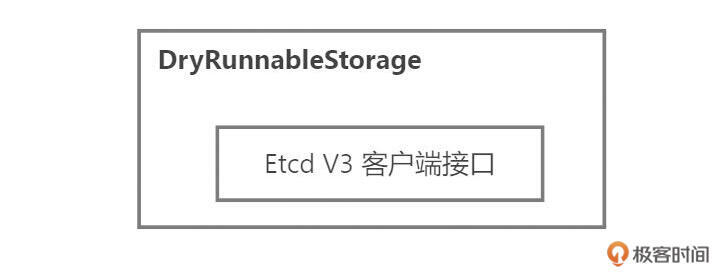
上面,我临时插入了 genericregistry.Store 实例的具体初始化方法,因为这是 HTTP 调用链中的关键一环。接下来,我们继续分析 HTTP 请求处理流程。
从上面的分析,我们可以知道 rest.NamedCreater 的 Create 方法,其实是 *genericregistry.Store 的 Create 方法。*genericregistry.Store 类型的 Create 方法的实际代码实现如下:
// 位于 staging/src/k8s.io/apiserver/pkg/registry/generic/registry/store.go 文件中
// Create inserts a new item according to the unique key from the object.
// Note that registries may mutate the input object (e.g. in the strategy
// hooks).  Tests which call this might want to call DeepCopy if they expect to
// be able to examine the input and output objects for differences.
func (e *Store) Create(ctx context.Context, obj runtime.Object, createValidation rest.ValidateObjectFunc, options *metav1.CreateOptions) (runtime.Object, error) {
    if utilfeature.DefaultFeatureGate.Enabled(features.RetryGenerateName) && needsNameGeneration(obj) {
        return e.createWithGenerateNameRetry(ctx, obj, createValidation, options)
    }

    return e.create(ctx, obj, createValidation, options)
}
可以看到,Create 方法最终是调用 e.create 执行具体的创建请求的,e.create 方法实现了 Kubernetes 中资源创建的完整流程,包括元数据的初始化、前置和后置处理、参数验证、对象存储等多个步骤。下一小节,我就来介绍下,具体是如何执行创建请求的。
HTTP 请求处理详情
从上面的代码分析,我们知道 createHandler 方法用来执行 HTTP 请求的核心逻辑。请求最终是通过 Store 类型的 create 方法来执行实际的 HTTP 请求处理逻辑。create 方法内容如下:
// 位于 staging/src/k8s.io/apiserver/pkg/registry/generic/registry/store.go 文件中
func (e *Store) create(ctx context.Context, obj runtime.Object, createValidation rest.ValidateObjectFunc, options *metav1.CreateOptions) (runtime.Object, error) {
    // 用于在创建操作结束时执行特定的清理工作,初始值为 finishNothing
    var finishCreate FinishFunc = finishNothing

    // Init metadata as early as possible.
    // 1. 从资源对象中获取 metav1.Object 类型的实例,metav1.Object 实例可以用来获取资源的元数据
    if objectMeta, err := meta.Accessor(obj); err != nil {
        return nil, err
    } else {
        // 2. 填充系统字段,例如:创建时间、UID。
        rest.FillObjectMetaSystemFields(objectMeta)
        // 3. 如果设置了 GenerateName 字段,并且资源 Name 是空,则调用 GenerateName() 方法自动生成资源名
        if len(objectMeta.GetGenerateName()) > 0 && len(objectMeta.GetName()) == 0 {
            objectMeta.SetName(e.CreateStrategy.GenerateName(objectMeta.GetGenerateName()))
        }
    }

    // 如果 e.BeginCreate 不为 nil,则执行创建前 Hook
    // BeginCreate 是一个可选的钩子,此钩子返回一个“事务式”提交/回滚函数。
    // 这个函数将在操作结束时调用,但在 AfterCreate 和 Decorator 之前调用,
    // 通过参数指示操作是否成功。如果此函数返回错误,则不会调用。
    // 几乎没有人会使用此钩子。
    if e.BeginCreate != nil {
        fn, err := e.BeginCreate(ctx, obj, options)
        if err != nil {
            return nil, err
        }
        finishCreate = fn
        defer func() {
            finishCreate(ctx, false)
        }()
    }

    // 4. 执行创建前处理,执行与创建相关的前置验证或处理。
    if err := rest.BeforeCreate(e.CreateStrategy, ctx, obj); err != nil {
        return nil, err
    }
    // at this point we have a fully formed object.  It is time to call the validators that the apiserver
    // handling chain wants to enforce.
    // 5. 资源参数校验
    if createValidation != nil {
        if err := createValidation(ctx, obj.DeepCopyObject()); err != nil {
            return nil, err
        }
    }

    // 6. 获取资源对象的名字
    name, err := e.ObjectNameFunc(obj)
    if err != nil {
        return nil, err
    }
    // 7. 根据资源对象的名字,拼接 Etcd 键
    key, err := e.KeyFunc(ctx, name)
    if err != nil {
        return nil, err
    }
    // 从 ctx 中提取出来,schema.GroupResource 类型的实例
    // schema.GroupResource 包含了 Group 和 Resource 字段
    qualifiedResource := e.qualifiedResourceFromContext(ctx)
    ttl, err := e.calculateTTL(obj, 0, false)
    if err != nil {
        return nil, err
    }
    // 8. 创建资源对象,要来保存资源对象内容
    // 使用 NewFunc 创建一个新的对象实例
    out := e.NewFunc()
    // 9. 调用 Storage 的 Create 方法,将资源对象保存在 Etcd 中
    if err := e.Storage.Create(ctx, key, obj, out, ttl, dryrun.IsDryRun(options.DryRun)); err != nil {
        // 创建失败时的错误处理
        err = storeerr.InterpretCreateError(err, qualifiedResource, name)
        err = rest.CheckGeneratedNameError(ctx, e.CreateStrategy, err, obj)
        if !apierrors.IsAlreadyExists(err) {
            return nil, err
        }
        if errGet := e.Storage.Get(ctx, key, storage.GetOptions{}, out); errGet != nil {
            return nil, err
        }
        accessor, errGetAcc := meta.Accessor(out)
        if errGetAcc != nil {
            return nil, err
        }
        if accessor.GetDeletionTimestamp() != nil {
            msg := &err.(*apierrors.StatusError).ErrStatus.Message
            *msg = fmt.Sprintf("object is being deleted: %s", *msg)
        }
        return nil, err
    }
    // The operation has succeeded.  Call the finish function if there is one,
    // and then make sure the defer doesn't call it again.
    // 10. 执行创建成功后的处理
    fn := finishCreate
    finishCreate = finishNothing
    fn(ctx, true)

    // 11. 执行创建后 Hook
    if e.AfterCreate != nil {
        e.AfterCreate(out, options)
    }
    if e.Decorator != nil {
        e.Decorator(out)
    }
    return out, nil
}
create 方法核心执行逻辑如下:
-
从资源对象中获取 metav1.Object 类型的实例,metav1.Object 实例可以用来获取资源的元数据。
-
填充系统字段,例如:创建时间、UID。
-
如果设置了 GenerateName 字段,并且资源 Name 是空,则调用 GenerateName() 方法自动生成资源名。
-
执行创建前处理,执行与创建相关的前置验证或处理。
-
资源参数校验。
-
获取资源对象的名字。
-
根据资源对象的名字,拼接 etcd 键。
-
创建资源对象,要来保存资源对象内容。
-
调用 Storage 的 Create 方法,将资源对象保存在 etcd 中。
-
执行创建成功后的处理。
-
执行创建后 Hook。
至此,整个 HTTP 请求链的核心处理逻辑,我就给你介绍完了。
上面介绍了核心流程,其中还有很多重要的细节功能点。在接下来的课程中,我会给你一一介绍。
课程总结
本节课以 Deployment 资源的创建请求为例,详细介绍了 kube-apiserver 处理创建请求的流程和实现。
首先通过流程图,概括介绍了 kube-apiserver 具体是如何处理创建请求的。之后,重点介绍了资源创建逻辑执行前的处理策略实现及策略内容。最后,我们学习了具体如何处理 HTTP 请求,并最终将资源数据保存在 etcd 存储中。
课后练习
-
在 HTTP 请求处理流程中,我没有介绍如何给资源设置默认值,请阅读 kube-apiserver 代码,查看 kube-apiserver 是如何给资源设置默认值的。
-
请再次梳理下 kube-apiserver 具体是如何处理资源创建请求的。
欢迎你在留言区与我交流讨论,如果今天的内容让你有所收获,也欢迎转发给有需要的朋友,我们下节课再见!
精选留言
2025-07-08 11:51:25
// New returns an empty object that can be used with Create after request data has been put into it.
// This object must be a pointer type for use with Codec.DecodeInto([]byte, runtime.Object)
New() runtime.Object
// Create creates a new version of a resource.
Create(ctx context.Context, obj runtime.Object, createValidation ValidateObjectFunc, options *metav1.CreateOptions) (runtime.Object, error)
}
接口,两个接口的Create的方法签名都不一样